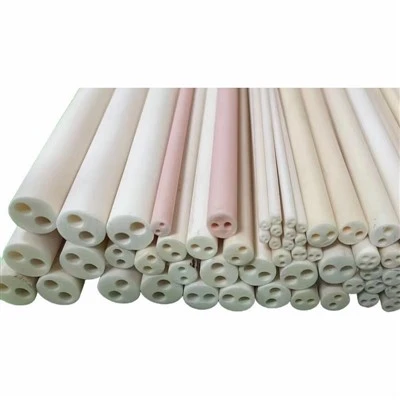
Product Overview
An alumina ceramic sleeve is fitted over a conductor or a shaft to insulate it from the surrounding structure and to protect it from mechanical damage. It is installed over conductors in transformers and reactors, over heating elements, over lead wires in motors and generators, and over shafts in high-temperature equipment. The two dimensions that decide whether the sleeve works in the assembly are the bore fit and the wall thickness uniformity.
Fit and Wall Thickness
A sleeve that does not fit the conductor will either not go on or will sit loose and allow the conductor to move. A sleeve with uneven wall thickness will sit off-center, which changes the clearance on one side and can cause the conductor to contact the housing. Both are checked as functional dimensions rather than cosmetic ones.
|
Item |
Value |
|
Material |
95%–99% alumina |
|
Inner diameter |
3–100 mm |
|
Outer diameter |
8–150 mm |
|
Wall thickness |
1–20 mm |
|
Length |
10–500 mm |
|
Volume resistivity |
> 10¹⁴ Ω·cm |
|
Maximum operating temperature |
95% alumina ≤ 1400°C / 99% alumina ≤ 1600°C |
|
End structure |
Plain / flanged / stepped |
The bore is finish-machined where the fit requires it. For precision assemblies, bore tolerance can be held within ±0.05 mm after machining, depending on the bore size and the length-to-diameter ratio.
Wall Thickness and Strength
A ceramic sleeve has a limit to how thin the wall can be relative to the bore. A wall that is too thin is more likely to crack during sintering and during assembly. The wall thickness to bore ratio is reviewed before the sleeve is quoted, and if the ratio is outside what the process can hold, we say so before production rather than after.
Where It Is Used
Conductor insulation sleeves for transformers and reactors
01
Insulating protection sleeves for heating elements
02
Lead wire insulation sleeves for motors and generators
03
Shaft insulation sleeves for high-temperature equipment
04
FAQ
Q: What bore tolerance can be held for the sleeve?
A: The bore tolerance is typically held within ±0.05 mm after finish machining. The achievable figure depends on the bore size and the length-to-diameter ratio. Provide the drawing and the required fit, and the tolerance will be confirmed for that specific size.
Q: Does a thin wall affect the strength of the sleeve?
A: There is a limit to the wall thickness to bore ratio. A wall that is too thin is more likely to crack during sintering and during assembly. Provide the specific dimensions and the wall thickness will be assessed for feasibility.
Hot Tags: alumina ceramic sleeve, China alumina ceramic sleeve manufacturers, suppliers, factory, Alumina Ceramic Tube, Alumina Tube, ceramic tube, High Temperature Ceramic Tube